What is the Open Web, and why it needs to come back
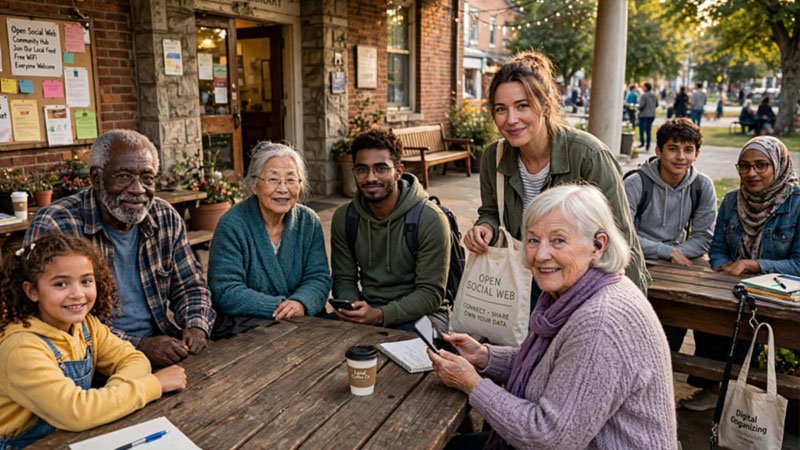
You write. You publish. You share the link. And then... you wait. You check the numbers. You boost the post. You tweak the hashtags. And still, somehow, it feels like shouting into a room where someone else controls the volume.
That feeling is not in your head. It is by design.
The internet you remember (or may not know about) was different
Not so long ago, publishing something online meant it was out there. Really out there. Anyone could find it, link to it, share it, bookmark it. There were no gatekeepers deciding who deserved an audience. No algorithm choosing winners and losers based on criteria nobody fully understood.
You had a blog. People subscribed. They read it. Simple.
That version of the internet had a name, even if nobody called it that at the time. It was the Open Web.
So what is the Open Web, exactly?
Think of it this way. The Open Web is the part of the internet that nobody owns.
No single company controls it. No platform decides who gets seen and who gets buried. Content lives on its own address, accessible to anyone with a browser, indexable by any search engine, linkable by anyone who wants to share it.
Your blog, when you host it yourself, is part of the open web. A personal website is. An RSS feed is. Even a newsletter, in many ways, is.
What is not part of the Open Web? A post locked inside a platform that requires an account to read. An audience you built on someone else's land, that disappears the day they change the rules. A feed curated by a machine whose only real job is to keep you scrolling.
What happened to it
The Open Web did not die. It got crowded out.
Somewhere in the last fifteen years, the platforms arrived and made everything easier. Easier to publish, easier to find an audience, easier to grow. And in exchange, quietly, we handed over the keys.
We moved our content inside their walls. We built our audiences inside their systems. We accepted that reach was something to be earned, or bought, one algorithm update at a time.
The platforms got the audience. We got the metrics.
Why this matters to you as a blogger
Here is the uncomfortable truth. If your readers only find you through one platform, you do not really have an audience. You have borrowed one.
The day that platform changes its algorithm, shifts its focus, or simply decides your content is less interesting than an ad, your reach drops. You did not lose followers. You lost access to followers you already had.
Bloggers are in a strange position. They do the hard work of creating original, thoughtful, independent content. And then they hand distribution over to systems that were never built to serve them.
The Open Web was built for exactly what bloggers do. And it is still there, waiting.
The good news: it is not gone
This is the part that most people miss. The Open Web never disappeared. It just got quieter while the platforms got louder.
There are protocols, communities, and tools being built right now that are bringing it back. Not as nostalgia. As something better, actually, than what we had before. Smarter, more connected, more resilient.
The Fediverse is part of that. Independent publishing is part of that. And a growing number of creators are figuring out that owning your audience is not just philosophically satisfying. It is strategically smarter.
Flipboard is already part of the answer, and always has been
Flipboard is not a walled garden. It curates the open web. Every story flipped into a magazine is a link to the original source, on the original site, written by the original author. No paywalled copies, no platform-exclusive content. Just real articles, from real publishers, surfaced by real humans who thought they were worth sharing.
That is a meaningful difference. Flipboard curators are, whether they think of it this way or not, librarians of the open web. They find good things, organize them, and pass them on. The content stays where it belongs: out in the open, accessible to anyone.
In a world of algorithmic feeds and closed ecosystems, that is quietly radical.
What FediBoard is doing about it
FediBoard started as a tool to give Flipboard curators more control. It grew into something with a larger purpose.
On one side, FediFind, our open web discovery engine, surfaces independent blogs and websites that deserve an audience but never had the platform muscle to find one. If you are a blogger publishing original work, FediFind is where you get seen outside the algorithm entirely.
On the other side, FediBoard helps users take their first steps away from walled gardens by offering great curated content through the Fediverse. Topic channels on Bluesky and Flipboard Social carry the best of what Flipboard curators find, into feeds that nobody owns and no company controls. Good content, open pipes, no manipulation.
The detox does not have to be brutal. It can start with one good article in a feed that actually respects you.
This is just the beginning
In the articles to come, we will go deeper. What the Fediverse actually is and why it matters. How to distribute your content without depending on any single platform. How tools like FediBoard help you stay on Flipboard while also planting your flag in the open web.
For now, just hold onto this: the internet was built to be open. It still can be. And bloggers, of all people, have the most to gain from making sure it stays that way.
The revolution is quieter than you think. And you are already part of it.
One last thing
What is not OPEN is CLOSED; to better control you, your habits, your thoughts (yes, you read that right). Their platform was never designed to make you succeed. Unless outrage, scandal, or division is your content strategy, you were never their priority. You were the product. Is this clear now? Say "YES" on Bluesky and move your activity, in parallel at least, on the Open Web. Be ready!
Thank you for your time 🙏
The social comments are the fuel for engagement on an article.